

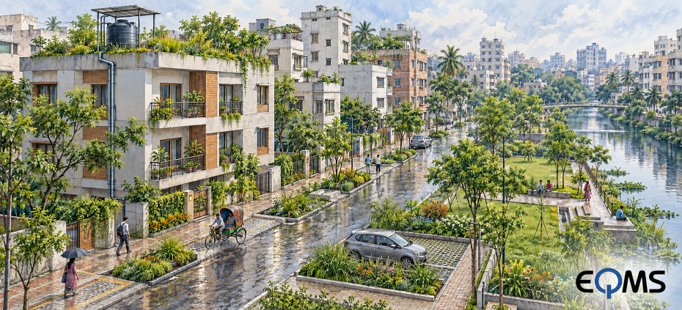
Low Impact Development (LID) can help Bangladesh’s cities
reduce rainfall-driven waterlogging by capturing and managing runoff close to
where it forms. Rain gardens, permeable surfaces and rainwater storage work
best alongside functioning drains, canals and flood protection systems.
Together, these measures can reduce pressure on urban drainage while improving
green space.
What Low Impact Development means
LID seeks to preserve or reproduce natural hydrological
processes through infiltration, storage, filtration and evapotranspiration.
Typical measures include green roofs, bioretention cells, vegetated swales,
permeable paving and rainwater harvesting. They can be introduced at building,
street or neighborhood scale. Related approaches, including Sustainable
Drainage Systems, Water Sensitive Urban Design and sponge-city planning, share
an emphasis on managing stormwater within the urban landscape. The choice of
measures must reflect local land, soil and drainage conditions. [4]
How it reduces urban runoff
Temporary storage slows the delivery of runoff to drains and
can lower peak discharge. Infiltration, evapotranspiration and reuse may also
reduce the volume discharged; detention alone mainly changes its timing.
Vegetation and filter media can improve water quality. Performance depends on
available storage, soil wetness, storm intensity and maintenance. Benefits
generally decline as rainfall intensity increases, so safe overflow routes
remain essential. LID primarily addresses local rainfall runoff; river floods,
storm surge and flash floods from large upstream catchments require wider
flood-risk measures. [2, 4]
Evidence and relevance for Bangladesh
A review of 96 studies reported average reductions of 42% in
peak runoff and 34% in runoff volume. These figures combine different
practices, climates and study settings; they indicate potential, rather than
guaranteed performance for a particular project. [1]
In Dhaka, a planning scenario for the
Hatirjheel–Gulshan–Banani lake system assumed permeable or vegetated treatment
of 30% of existing built-up surfaces. Estimated peak discharge decreased by
11.1% for a five-year design event, with a sensitivity range of 7.9–12.7%. The
authors identify this as a planning-level estimate, not measured field
performance. It supports local feasibility studies and monitored pilot
projects. [3]
Practical applications and implementation
Public campuses, housing developments, footpaths, parking
areas and road corridors offer potential locations for LID. Roof runoff can
feed storage tanks, landscaped areas can accommodate bioretention, and suitable
paved areas can use permeable surfaces. Green roofs require checks on
structural capacity, waterproofing and maintenance access. Existing canals,
lakes and open spaces must retain their drainage and storage functions.
Design must reflect site conditions. Poorly draining soils
may require underdrains and controlled discharge. Infiltration needs assessment
of seasonal groundwater levels, contamination and nearby foundations. Coastal
and low-lying sites require checks on river or tidal backwater, while hilly
areas need attention to slope stability, sediment and safe overflow routes. [4]
Implementation should begin with catchment mapping, surveys
and drainage assessment. Compare options using hydrological and hydraulic
modelling, then pilot measures where ownership and maintenance responsibilities
are clear. Monitor rainfall, ponding duration, water levels and upkeep costs
before scaling. Routine removal of litter and sediment is essential to preserve
inlets, outlets and permeable surfaces.
Conclusion
For Bangladesh, LID offers a practical way to manage part of
the urban runoff burden when combined with drainage improvements and protection
of water spaces. EQMS Consulting Limited’s environmental assessment, water
resources management and flood-risk analysis can support site selection, design
and monitoring, with realistic performance objectives and maintenance needs.
References
[1] Huq, M. E., et al. (2026). Emerging insights into low impact development (LID) strategy
for urban flood resilience under climate change. Environmental Development, 58,
101430. 10.1016/j.envdev.2026.101430
[2] Sohn, W., et al. (2019).
The influence of climate on the effectiveness of low impact development: A
systematic review. Journal of Environmental Management, 236, 365–379. 10.1016/j.jenvman.2018.11.041
[3] Haque, M. M., et al.
(2026). Low-impact development and sponge city adaptation for urban stormwater
retention in Dhaka: Assessing the Hatirjheel–Gulshan–Banani lake system. Asian
Journal of Water, Environment and Pollution. 10.36922/AJWEP026190136
[4] U.S. Environmental
Protection Agency. Green Infrastructure Design Strategies. Accessed 29
September 2026. EPA design guidance
Share this page via